
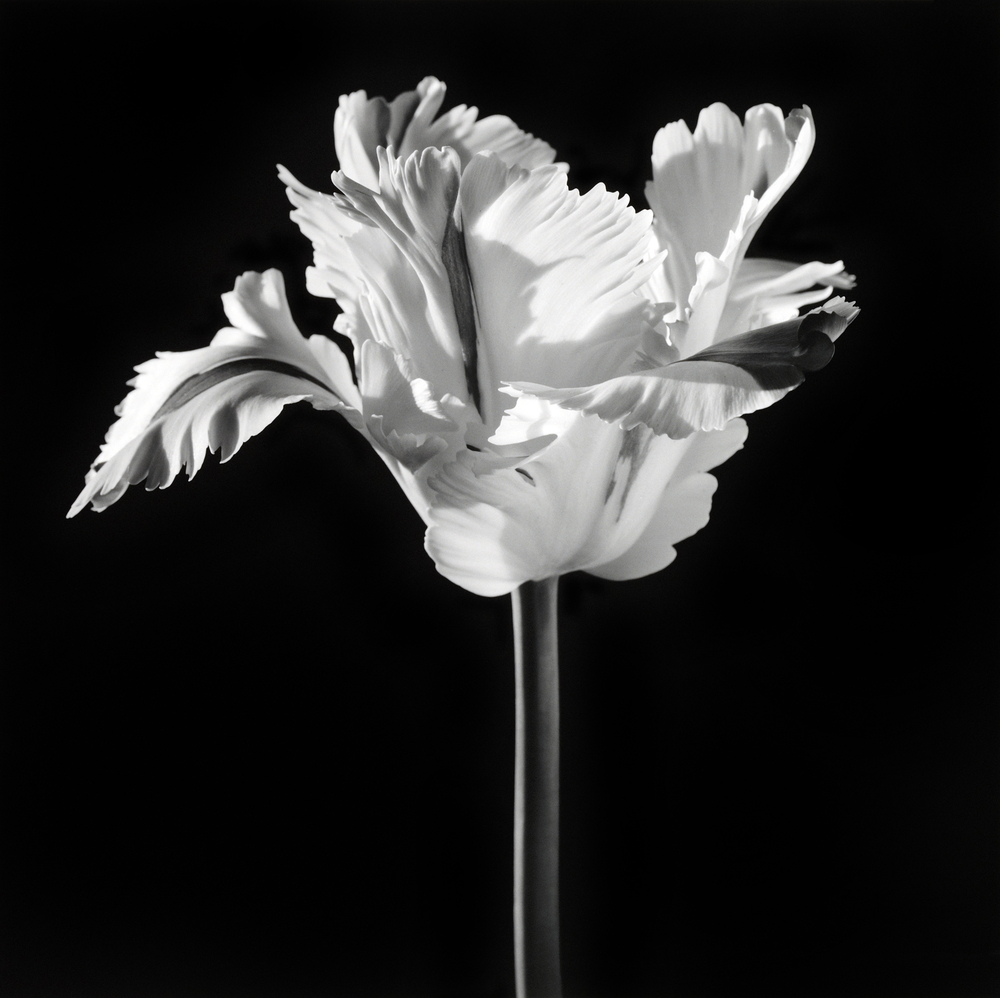
Parrot Tulip, 1988
If the European Fine Art Foundation has been trying to update its image, what better way to do it than by turning to a medium that has become ubiquitous in modern life?
The TEFAF fair, which begins on March 14 in Maastricht, the Netherlands, is this year placing additional emphasis on photography, a reflection of its yearslong efforts to bridge the old masters, objets d’art and antiques that it has long been known for, and the contemporary art that makes up an increasingly significant part of its offerings.
The event always tries to “represent the best of human creativity” in each medium across all eras, Will Korner, the head of fairs for TEFAF, said in a phone interview. For example, “you have the best silversmiths of all time, from ancient Roman silver all the way up to contemporary artists working with silver,” he said, and the same goes for jewelry, oil on canvas and beyond.
But, he continued, “it seemed to us that photography as a medium wasn’t as represented as it should be within the fair.”
James Dwyer, a director at Michael Hoppen Gallery in London, said in a phone interview that “photography for many, many years was always considered the poor cousin of painters and sculptors and such.”
That has started to change as it has become a crucial part of the way people communicate. “We see pictures all the time, every day, everywhere,” he said. “It’s basically how we live our lives.” Dwyer added that because of this, it is a good time to be showing at TEFAF. “Photography is on everyone’s minds.”
André Buchmann, who founded Buchmann Galerie in Berlin, said that the gallery is attending TEFAF Maastricht for the first time in years, and that historically “there was such a debate about photography being accepted as an art form.” So showing at TEFAF now, he said, is “inspiring,” as the fair brings together “the whole range of what culture can be.”
His gallery will exhibit “Contact With Trees,” a large-scale black-and-white panel from 1987 by the German artists Anna and Bernhard Blume, who were known for their elaborately staged photographs. In this work, they photographed a man clinging to a tree in a forest badly damaged by acid rain.
Buchmann said that the conversation about photography evolved over time: The artistic value of black-and-white photography was gradually accepted, while color struggled to be taken seriously when it became more common as an art form in the 1960s.
This is still true in some ways today. “We deal with photography on a daily basis,” he said. “We have it all in our cellphones. But it’s always color.” So it is almost “refreshing” to see black-and-white photographs, he added. “We kind of look back now at black and white and say, ‘Oh, wow, this looks like real art.’"
The emphasis on photography at this year’s TEFAF Maastricht, which had its first edition in 1988, is part of the fair’s decade-plus efforts to attract younger collectors and highlight contemporary art alongside the pre-20th-century paintings and sculptures that it is famous for showing.
Korner, of TEFAF, said that contemporary art has for several years made up about one-third of the fair’s offerings, so they’re mostly trying to “share that message” a bit more. But, he continued, the fair’s tapestry of historic art makes TEFAF a unique context for photographers to showcase their work.
Michael Hoppen Gallery, for instance, is exhibiting elaborate, abstract maps by Sohei Nishino, a Japanese photographer. He spends months taking tens of thousands of photographs of a city — most recently, Venice — and then splices them together to form what Dwyer, the director, described as a map created “through experience and memory.” At TEFAF, Nishino’s works will be displayed alongside maps of the same cities from as early as the 1800s, provided by Daniel Crouch Rare Books.
This link between the old and the new is also the subtext of a series of flower photographs taken by Robert Mapplethorpe over the course of his career. The series, which will be shown by Galerie Thomas Schulte of Berlin, was selected as one of the fair’s seven Focus exhibitions, which are each devoted to a particular artist or idea.
Thomas Schulte, the founder of the gallery, said in a phone interview that Mapplethorpe’s work was a particularly good fit for Maastricht because of how important the flower has been as a motif in Dutch culture and art. “You can say that the Dutch still life, and the drawings of the 17th century from Holland, all feed into his work, and he has a modern aesthetic version of that,” Schulte said.
He added that unlike the Dutch and Flemish masters, Mapplethorpe “completely reduces the aesthetic concept to one flower in one vase, but it is in a way the same thing” — a contemporary version of the elaborate floral paintings that are part of the fair’s bread and butter.
Mapplethorpe, who died in 1989, himself always characterized his photographs as part of a similar tradition. “I’m looking for perfection in form,” he once said. “I do that with portraits. I do it with flowers. It’s not different from one subject to the next. I am trying to capture what could be sculpture.”
Another work that will be featured at TEFAF is “Tulips” by Erwin Olaf, a Dutch photographer who died in 2023. The photograph, from 1986, which will be shown by Galerie Ron Mandos of Amsterdam, is both “a reference to Dutch culture” and to Mapplethorpe’s flowers, said Lars Been, the gallery’s curator. He added that Olaf was greatly influenced by Mapplethorpe, and sometimes echoed his techniques when photographing the naked human form, or in his style of taking square, black-and-white photos.
Schulte said that including works by Mapplethorpe and other photographers is one way that TEFAF is trying to bring its offerings into the modern age. But, he added, it also reflects the realities of the contemporary market, which has in recent years been stronger than that of the market for old masters — which also tend to be hidden away in private collections and only go on sale every few decades.
The beginning of a trend toward the contemporary could be seen even before Mapplethorpe’s death, as photography began to prove popular at auctions. “The mid-80s sees photography rising in value in terms of the art market,” Schulte said, “and as something that people would be collecting.”
Korner said that though market concerns are a consideration, “one of the quickest ways to kill the fair” would be to lose focus on quality in the interest of modernizing or satisfying demand for a particular medium or concept.
“There are some fantastic photographers who are seen as fantastic photographers, but realistically they’re fantastic artists” as well, he said, adding, “That’s really the message.”